
Norimichi Masaki
Graduated from the Department of Forest Science, Faculty of Life and Environmental Sciences, Kyoto Prefectural University in 2023, and completed the Master’s Program in Environmental Science, Graduate School of Life and Environmental Sciences, Kyoto Prefectural University in 2025. Developed an interest in the energy and material utilization of forest resources and engaged in research on wood-based biorefinery. Currently works in research and development at an activated carbon manufacturer, aiming to expand product applications of wood-derived raw materials.

Takashi Hosoya
Associate Professor, Graduate School of Life and Environmental Sciences, Kyoto Prefectural University
Graduated from Faculty of Agriculture, Kyoto University in 2003. Completed the Doctoral Program in Graduate School of Energy Science, Kyoto University in 2008.
After serving as a Japan Society for the Promotion of Science (JSPS) Research Fellow, Postdoctoral Researcher at the University of Natural Resources and Life Sciences, Vienna (BOKU), Designated Lecturer at Kyoto Prefectural University, and Assistant Professor at the same university, assumed the current position in October 2019.
Specializes in biomass chemistry and physical organic chemistry.

Hisashi Miyafuji
Professor, Graduate School of Life and Environmental Sciences, Kyoto Prefectural University
Graduated from the Department of Forest and Biomaterials Science, Faculty of Agriculture, Kyoto University in 1994. Completed the Master’s program at the Graduate School of Agriculture, Kyoto University in 1996.
Researcher at Daiken Corporation from 1996 to 1997. Research Associate at the Graduate School of Energy Science, Kyoto University from 1997 to 2010 (title changed to Assistant Professor in 2007). Postdoctoral Researcher at the Department of Agricultural Sciences, University of Natural Resources and Life Sciences, Vienna (IFA-Tulln) from 2001 to 2002. Associate Professor at Kyoto Prefectural University in 2010. Appointed to the present position in 2016.
Specializes in biorefinery and chemical processing of wood.
Although hydrogen energy has attracted considerable attention as a means of reducing dependence on fossil fuels and mitigating climate change, current hydrogen production relies predominantly on fossil-fuel-based processes. In this study, we discovered that mixing Japanese cedar (Cryptomeria japonica) wood powder with sodium hydroxide in a solid–solid state and heating the mixture at temperatures as low as 25–120°C is sufficient to generate hydrogen gas. This so-called "low-temperature reaction" proceeds via a reaction pathway entirely distinct from conventional thermochemical processes such as pyrolysis, and was confirmed to occur with all three major constituents of wood. The findings suggest promising applications in utilizing industrial waste heat and enabling low-cost, small-scale hydrogen production.
Achieving a low-carbon society by reducing dependence on fossil fuels has become an urgent global imperative in the context of climate change mitigation1,2. Hydrogen has emerged as a promising next-generation energy carrier3,4, and the development of hydrogen production technologies based on renewable energy sources is of paramount importance5,6. This paper introduces a novel low-temperature hydrogen production process combining woody biomass (timber) with sodium hydroxide (NaOH), a system that has no precedent in the existing literature.
The vast majority of hydrogen produced worldwide is derived from fossil fuel feedstocks. Steam methane reforming of natural gas accounts for approximately 48% of global production, followed by naphtha reforming (~30%) and coal gasification (~18%); water electrolysis contributes only ~4%7. Because these fossil fuel-based processes inevitably co-produce carbon dioxide (CO2), they are fundamentally incompatible with deep decarbonization goals.
Fossil-free alternatives include water electrolysis and biomass gasification. While electrolysis is operationally straightforward, it faces challenges such as co-generation of hazardous chlorine gas when seawater is used and regional disparities in freshwater availability. Biomass, by contrast, is a carbon-neutral resource; lignocellulosic feedstocks such as timber are non-edible and therefore do not compete with food supply chains8, making biomass-derived hydrogen particularly attractive from a sustainability perspective.
The principal technologies under research and development for hydrogen production from biomass are summarized below.
(1) Microbial (dark) fermentation9,10 Anaerobic fermentation of organic biomass such as food waste at near-ambient temperatures yields a gas mixture rich in H2 and CO2. However, overall energy efficiency is low and volatile organic acids are produced as by-products, which has motivated investigation of integrated dark-fermentation/anaerobic-digestion processes.
(2) Supercritical water gasification11,12 Biomass is gasified in supercritical water at approximately 600°C and 25 MPa, producing a gas mixture composed primarily of H2, CO2, and methane (CH4). Although near-complete gasification is achievable, practical challenges remain, including catalyst deactivation, continuous feedstock feeding, and reactor plugging.
(3) Pyrolytic gasification13,14 Biomass is heated at high temperature under oxygen-limited conditions to generate H2, carbon monoxide (CO), and various hydrocarbons13. Significant hydrogen evolution requires temperatures exceeding 600°C, and the condensable tar produced causes downstream pipeline fouling. Tar cracking can demand temperatures above 1100°C, entailing substantial energy penalties14. Addition of alkali metal salts as catalysts has been shown to lower the hydrogen evolution temperature and reduce tar yields15,16, yet the process remains inherently a high-temperature one.
Among prior studies employing NaOH as a catalyst for biomass conversion17-21, several reports document hydrogen evolution when a solid mixture of glucose and NaOH is heated to approximately 100 °C17,18. This is a remarkably anomalous phenomenon given that significant thermochemical hydrogen generation is generally observed only above 600°C.
Hydrogen generation in this low-temperature regime (~120 °C) is hypothesized to proceed via a reaction pathway fundamentally different from established pyrolysis chemistry. At the same time, low-grade waste heat below 200°C represents more than 75% of the total industrial waste heat potential yet remains largely unutilized19. Successfully harnessing this temperature range for biomass-to-hydrogen conversion would therefore carry significant implications for industrial energy efficiency.
Although wood is a carbon-neutral, non-food-competing feedstock, no prior study had examined low-temperature hydrogen production from wood in the presence of NaOH. The present study therefore focused on the solid–solid reaction between Japanese cedar (Cryptomeria japonica) wood powder and NaOH at temperatures of 100–120°C, with a particular emphasis on elucidating hydrogen generation behavior.
Biomass samples – Japanese cedar wood powder, cellulose, glucose, lignin (sodium lignosulfonate), and xylan – together with NaOH (300 mg each) were sealed in 20-mL headspace vials and heated at temperatures ranging from 25 to 250°C for 0.5–24 h. Reactions were conducted under either an Ar or O2 atmosphere. After each run, a 1-mL aliquot of the headspace gas was withdrawn with a gas-tight syringe and analyzed by gas chromatography to quantify the volumes of H2, CH4, and CO generated.
A mixture of Japanese cedar wood powder and NaOH was found to evolve a measurable, albeit small, quantity of hydrogen even at 25 °C (Table 1). This observation strongly implies the existence of a reaction mechanism entirely distinct from thermochemical pyrolysis, and we hereafter refer to this phenomenon as the "low-temperature reaction." Crucially, the low-temperature reaction proceeded under both Ar and O2 atmospheres.
Experiments in this section were conducted using an aluminum block heater. Hydrogen yield increased monotonically with temperature, with a pronounced surge observed in the 120–200 °C range (Table 1); this trend was consistent under both Ar and O2 atmospheres. Below 120 °C, the low-temperature reaction is considered to be the dominant pathway; above 200 °C, additional reaction mechanisms likely contribute. The H2 conversion at 250 °C reached approximately 30%.
| Temp. (°C) | Atmosphere | H2 yield (mL) | H2 conversion (%) |
| 25 | Ar | 0.00059 | 0.00031 |
| 25 | O2 | 0.00072 | 0.00038 |
| 120 | Ar | 1.9 | 1.0 |
| 120 | O2 | 2.9 | 1.5 |
| 200 | Ar | 33.8 | 17.8 |
| 200 | O2 | 34.3 | 18.1 |
| 250 | Ar | 57.9 | 30.6 |
| 250 | O2 | 60.2 | 31.8 |
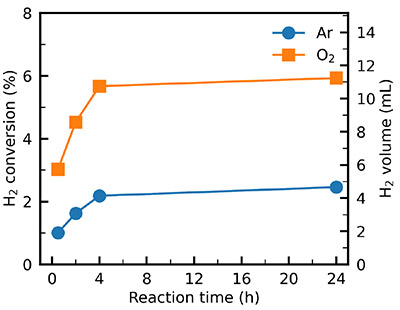
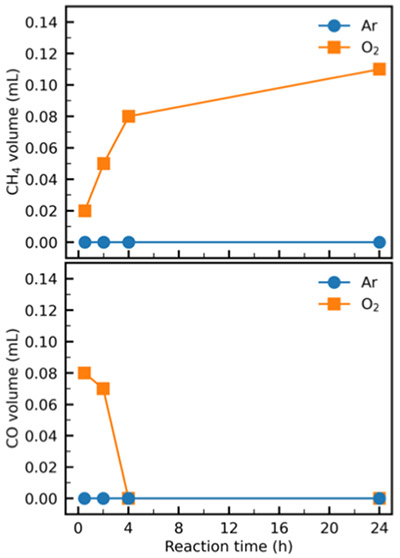
Experiments in this section were conducted using an oil-bath heater. At 120 °C, hydrogen yield reached a plateau after approximately 4 h and showed no further increase thereafter (Fig 1), suggesting that the number of reactive sites accessible to the low-temperature reaction is finite. In addition to hydrogen, trace amounts of CH4 and CO were detected (Fig 2). Both species were absent under Ar but present in small quantities under O2. The CO concentration decreased with prolonged reaction time, consistent with oxidation to CO2; the absence of detectable CO2 in the headspace is attributed to absorption by the excess NaOH present. As shown in a href="#fig_1">Fig 1 and Fig 2, hydrogen was by far the predominant gaseous product, with CH4 and CO yields being negligibly small.
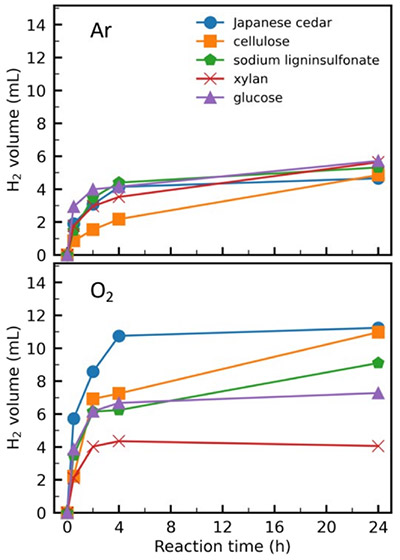
Hydrogen generation was confirmed for all feedstocks examined — Japanese cedar, cellulose, xylan, lignin, and glucose (Fig 3). Because the biomass series encompasses cellulose, xylan (a representative hemicellulose), and lignin (sodium lignosulfonate), these results indicate that the low-temperature reaction proceeds with all three principal structural constituents of wood, demonstrating the feasibility of hydrogen production directly from timber. Under an O2 atmosphere, the hydrogen evolution rate from Japanese cedar was notably higher than that from any individual constituent, suggesting a possible synergistic interaction among the wood components.
The most distinctive feature of the low-temperature reaction reported here is the dramatically reduced operating temperature relative to all existing biomass-to-hydrogen technologies. Table 2 compares the reaction temperatures and key characteristics of the principal competing approaches.
| Technology | Reaction temperature | Key challenges / characteristics |
| Microbial fermentation | Ambient – ~40 °C | Low energy efficiency; organic acids as by-products |
| Supercritical water gasification | ~600 °C, 25 MPa | Extreme temperature/pressure conditions; catalyst deactivation |
| Pyrolytic gasification | 600–1100 °C | Tar fouling; high energy consumption |
| NaOH low-temperature reaction (this study) | 25–120 °C | Utilization of industrial waste heat; low cost |
Pyrolytic gasification requires temperatures exceeding 600 °C for meaningful hydrogen generation, and tar cracking can necessitate operation at up to 1100 °C. Supercritical water gasification likewise demands temperatures of approximately 600 °C. In sharp contrast, the low-temperature reaction described in this study generates hydrogen at 25–120 °C.
Industrial waste heat below 200 °C constitutes more than 75% of the total waste heat discharged, yet the bulk of it remains unexploited19. The low-temperature reaction has the potential to utilize such low-grade waste heat as its energy source, thereby offering substantial improvements in overall energy efficiency. The elimination of high-temperature, high-pressure process equipment would also facilitate process simplification, miniaturization, and cost reduction.
Furthermore, the timber feedstock is carbon-neutral and does not compete with food production, rendering it a genuinely sustainable biomass resource. Taken together, these attributes position the NaOH-mediated low-temperature biomass-to-hydrogen process as a fundamentally novel hydrogen production approach with transformative potential not found in existing technologies.
This study experimentally demonstrated that mixing Japanese cedar wood powder with NaOH in a solid–solid configuration and heating the mixture at temperatures as low as 100–120 °C is sufficient to produce hydrogen. The low-temperature reaction proceeds even at ambient temperature, distinguishing it fundamentally from known thermochemical pathways. Moreover, the reaction was confirmed to occur with all major structural constituents of wood — cellulose, hemicellulose, and lignin.
Although the detailed reaction mechanism remains to be elucidated and warrants further investigation, the present findings represent a promising step toward a low-temperature, low-cost, carbon-neutral hydrogen production process driven by industrial waste heat.