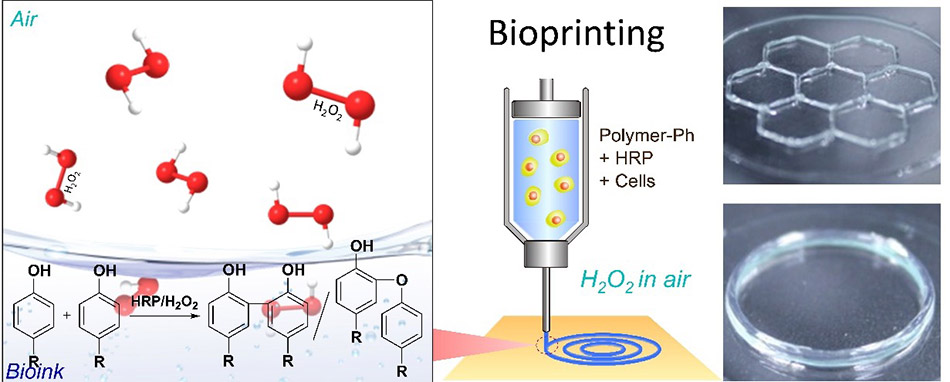
Fig. 1. Schematic illustration of HRP-mediated extrusion bioprinting in air Dissolved hydrogen peroxide in the surrounding air initiates horseradish peroxidase (HRP)-catalyzed crosslinking of phenol-modified hyaluronic acid in the extruded bioink, enabling shape retention after deposition. Representative printed constructs are shown on the right. Adapted from Ref. 12.
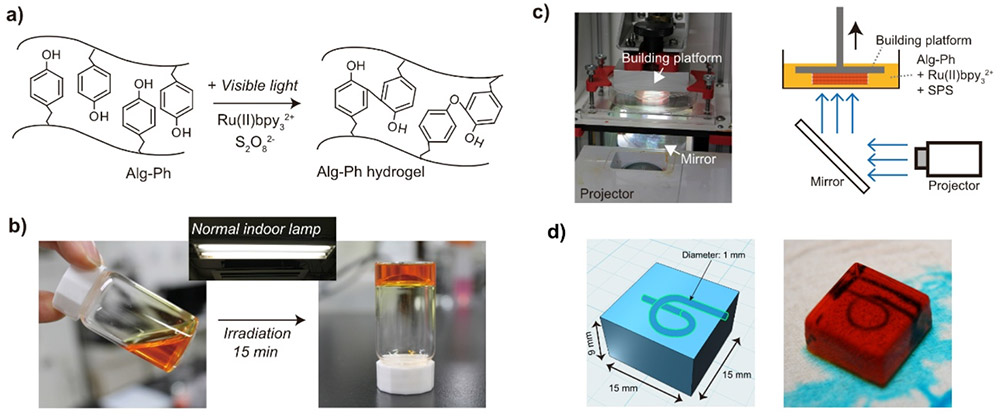
Fig. 2 Visible light-induced hydrogelation of phenol-modified alginate (Alg-Ph) and its application to stereolithographic bioprinting (a) Schematic of Ru(II)/persulfate-mediated visible light crosslinking of Alg-Ph. (b) Gelation of the Alg-Ph precursor solution upon irradiation with visible light. (c) Experimental setup for visible light-based stereolithographic bioprinting. (d) Representative hydrogel construct fabricated by this method. Adapted from Ref. 31.
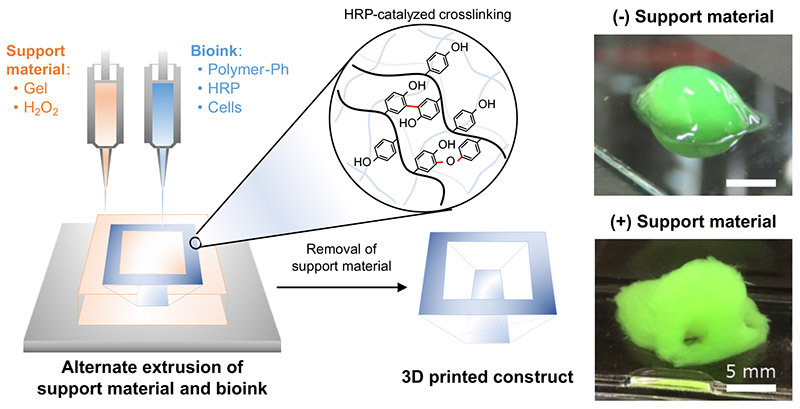
Fig. 3 Schematic illustration of support-assisted bioprinting using a bioink containing phenolated hyaluronic acid (HA-Ph) and HRP, and a support material containing H2O2 Upon alternating extrusion of the bioink and the support material, HRP-catalyzed crosslinking is induced at the interface, leading to improved shape retention of the printed construct. Representative printed constructs obtained in the absence and presence of support material are shown on the right. Adapted from Ref. 40.
Gao X, Chen J, Zhang X, Xu T. 3D bioprinting for personalized medicine: advances, challenges, and future directions. ACS Biomater Sci Eng. 2025;11(11):6334–58.
Panda S, Hajra S, Mistewicz K, Nowacki B, In-Na P, Krushynska A, et al. A focused review on three-dimensional bioprinting technology for artificial organ fabrication. Biomater Sci. 2022;10(18):5054–80.
Lee KY, Mooney DJ. Alginate: properties and biomedical applications. Prog Polym Sci. 2012;37(1):106–26.
Lee KY, Mooney DJ. Hydrogels for tissue engineering. Chem Rev. 2001;101(7):1869–79.
Rumon MMH, Akib AA, Sarkar SD, Khan MAR, Uddin MM, Nasrin D, et al. Polysaccharide-based hydrogels for advanced biomedical engineering applications. ACS Polym Au. 2024;4(6):463–86.
Gao Q, Kim BS, Gao G. Advanced strategies for 3D bioprinting of tissue and organ analogs using alginate hydrogel bioinks. Mar Drugs. 2021;19(12):708.
Zhu Z, Wang YM, Yang J, Luo XS. Hyaluronic acid: a versatile biomaterial in tissue engineering. Plast and Aesthet Res. 2017;4:219–27.
Banigo AT, Nauta L, Zoetebier B, Karperien M. Coaxial bioprinting of enzymatically crosslinkable hyaluronic acid-tyramine bioinks for tissue regeneration. Polymers (Basel). 2024;16(17):2470.
Mueller E, Poulin I, Bodnaryk WJ, Hoare T. Click chemistry hydrogels for extrusion bioprinting: progress, challenges, and opportunities. Biomacromolecules. 2022;23(3):619–40.
Petta D, Grijpma DW, Alini M, Eglin D, D'Este M. Three-dimensional printing of a tyramine hyaluronan Derivative with double gelation mechanism for independent tuning of shear thinning and postprinting curing. ACS Biomater Sci Eng. 2018;4(8):3088–98.
Sakai S, Mochizuki K, Qu Y, Mail M, Nakahata M, Taya M. Peroxidase-catalyzed microextrusion bioprinting of cell-laden hydrogel constructs in vaporized ppm-level hydrogen peroxide. Biofabrication. 2018;10(4):045007.
Elangwe CN, Morozkina SN, Olekhnovich RO, Krasichkov A, Polyakova VO, Uspenskaya MV. A review on chitosan and cellulose hydrogels for wound dressings. Polymers (Basel). 2022;14(23):5163.
Yu Y, Su Z, Peng Y, Zhong Y, Wang L, Xin M, et al. Recent advances in modifications, biotechnology, and biomedical applications of chitosan-based materials: a review. Int J Biol Macromol. 2025;289:138772.
Hidaka M, Sakai S. Photo- and schiff base-crosslinkable chitosan/oxidized glucomannan composite hydrogel for 3D bioprinting. Polysaccharides. 2025;6(1):19.
Hidaka M, Kojima M, Nakahata M, Sakai S. Visible light-curable chitosan ink for extrusion-based and vat polymerization-based 3D bioprintings. Polymers (Basel). 2021;13(9):1382.
Sakai S, Yamamoto S, Hirami R, Hidaka M, Elvitigala KCML. Enzymatically gellable chitosan inks with enhanced printability by chitosan nanofibers for 3D printing of wound dressings. Eur Polym J. 2024;210:112960.
Carvalho JPF, Lameirinhas NS, Teixeira MC, Luis JL, Oliveira H, Oliveira JM, et al. All-cellulose hydrogel-based bioinks for the versatile 3D bioprinting of different cell lines. Biomacromolecules. 2025;26(3):1761–70.
Melilli G, Carmagnola I, Tonda-Turo C, Pirri F, Ciardelli G, Sangermano M, et al. DLP 3D printing meets lignocellulosic biopolymers: carboxymethyl cellulose inks for 3D biocompatible hydrogels. Polymers (Basel). 2020;12(8):1655.
Teixeira MC, Lameirinhas NS, Carvalho JPF, Luis J, Oliveira H, Oliveira JM, et al. Biobased hydrogel bioinks of pectin, nanocellulose and lysozyme nanofibrils for the bioprinting of A375 melanoma cell-laden 3D in vitro platforms. Int J Biol Macromol. 2024;282(Pt 5):136958.
Mubarok W, Zhang C, Sakai S. 3D bioprinting of sugar beet pectin through horseradish peroxidase-catalyzed cross-linking. ACS Appl Bio Mater. 2024;7(5):3506–14.
Mubarok W, Elvitigala K, Kotani T, Sakai S. Visible light photocrosslinking of sugar beet pectin for 3D bioprinting applications. Carbohydr Polym. 2023;316:121026.
Alfinaikh RS, Alamry KA, Hussein MA. Sustainable and biocompatible hybrid materials-based sulfated polysaccharides for biomedical applications: a review. RSC Adv. 2025;15(6):4708–67.
Lafuente-Merchan M, Ruiz-Alonso S, Zabala A, Galvez-Martin P, Marchal JA, Vazquez-Lasa B, et al. Chondroitin and dermatan sulfate bioinks for 3D bioprinting and cartilage regeneration. Macromol Biosci. 2022;22(3):e2100435.
Goto R, Terasawa M, Kojima M, Matsuda K, Nishiura K, Sakai S. Synthesis and application of phenol-grafted rhamnan sulfate for 3D bioprinting. J Biomater Sci Polym Ed. 2025;36(6):779–95.
Kurisawa M, Chung JE, Yang YY, Gao SJ, Uyama H. Injectable biodegradable hydrogels composed of hyaluronic acid-tyramine conjugates for drug delivery and tissue engineering. Chem Commun. 2005;(34):4312–4.
Moller S, Weisser J, Bischoff S, Schnabelrauch M. Dextran and hyaluronan methacrylate based hydrogels as matrices for soft tissue reconstruction. Biomol Eng. 2007;24(5):496–504.
Kim MH, Lin CC. Norbornene-functionalized methylcellulose as a thermo- and photo-responsive bioink. Biofabrication. 2021;13(4):045023.
Ding F, Wu S, Wang S, Xiong Y, Li Y, Li B, et al. A dynamic and self-crosslinked polysaccharide hydrogel with autonomous self-healing ability. Soft Matter. 2015;11(20):3971–6.
Sakai S, Kamei H, Mori T, Hotta T, Ohi H, Nakahata M, et al. Visible light-induced hydrogelation of an alginate derivative and application to stereolithographic bioprinting using a visible light projector and acid red. Biomacromolecules. 2018;19(2):672–9.
Wilson SA, Cross LM, Peak CW, Gaharwar AK. Shear-thinning and thermo-reversible nanoengineered inks for 3D bioprinting. ACS Appl Mater Interfaces. 2017;9(50):43449–58.
Schwab A, Helary C, Richards RG, Alini M, Eglin D, D'Este M. Tissue mimetic hyaluronan bioink containing collagen fibers with controlled orientation modulating cell migration and alignment. Mater Today Bio. 2020;7:100058.
Liu W, Zhang YS, Heinrich MA, De Ferrari F, Jang HL, Bakht SM, et al. Rapid continuous multimaterial extrusion bioprinting. Adv Mater. 2017;29(3):1604630.
Ravanbakhsh H, Karamzadeh V, Bao G, Mongeau L, Juncker D, Zhang YS. Emerging technologies in multi-material bioprinting. Adv Mater. 2021;33(49):e2104730.
Sakai S, Ueda K, Gantumur E, Taya M, Nakamura M. Drop-on-drop multimaterial 3D bioprinting realized by peroxidase-mediated cross-linking. Macromol Rapid Commun. 2018;39(3):1700534.
Sakai S, Kotani T, Harada R, Goto R, Morita T, Bouissil S, et al. Development of phenol-grafted polyglucuronic acid and its application to extrusion-based bioprinting inks. Carbohydr Polym. 2022;277:118820.
Sakai S, Ohi H, Hotta T, Kamei H, Taya M. Differentiation potential of human adipose stem cells bioprinted with hyaluronic acid/gelatin-based bioink through microextrusion and visible light-initiated crosslinking. Biopolymers. 2018;109(2):e23080.
Sakai S, Harada R, Kotani T. Freeform 3D bioprinting involving ink gelation by cascade reaction of oxidase and peroxidase: a feasibility study using hyaluronic acid-based ink. Biomolecules. 2021;11(12):1908.
Kotani T, Mubarok W, Hananouchi T, Sakai S. Horseradish peroxidase-mediated bioprinting via bioink gelation by alternately extruded support material. ACS Biomater Sci Eng. 2023;9(10):5804–12.
Kotani T, Hananouchi T, Sakai S. Enhancing visible light-induced 3D bioprinting: alternating extruded support materials for bioink gelation. Biomed Mater. 2025;20(3):0355005.
Prasetyaningrum PW, Mubarok W, Kotani T, Sakai S. Development of starch-based support material alternately extruded with gelatin-based bioinks for 3D bioprinting application. Bioprinting. 2025;51:e00439.
Hidaka M, Kojima M, Zhang C, Okano Y, Sakai S. Experimental and numerical approaches for optimizing conjunction area design to enhance switching efficiency in single-nozzle multi-ink bioprinting systems. Int J Bioprint. 2024;10(5):4091.
Hidaka M, Kojima M, Sakai S. Micromixer driven by bubble-induced acoustic microstreaming for multi-ink 3D bioprinting. Lab Chip. 2024;24(19):4571–80.
Fareez UNM, Naqvi SAA, Mahmud M, Temirel M. Computational fluid dynamics (CFD) analysis of bioprinting. Adv Healthc Mater. 2024;13(20):e2400643.
Xu Y, Sarah R, Habib A, Liu Y, Khoda B. Constraint based Bayesian optimization of bioink precursor: a machine learning framework. Biofabrication. 2024;16(4):045031.
Freeman S, Calabro S, Williams R, Jin S, Ye K. Bioink formulation and machine learning-empowered bioprinting optimization. Front Bioeng Biotechnol. 2022;10:913579.
Zhang C, Elvitigala KCML, Mubarok W, Okano Y, Sakai S. Machine learning-based prediction and optimisation framework for as-extruded cell viability in extrusion-based 3D bioprinting. Virtual Phys Prototyp. 2024;19(1):e2400330.
Zhang C, Elvitigala K, Sakai S. AI-powered printability evaluation framework for 3D bioprinting using Hausdorff distance metrics. Biofabrication. 2026;18(1):015015.