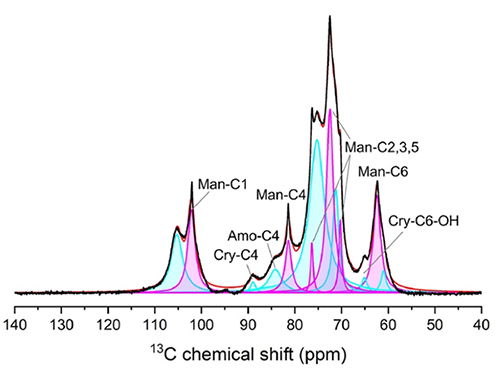
図 4. 5パス処理後のHCNFの13C CP-MAS固体NMRスペクトル(600 MHz Bruker Avance III 分光計)(黒) デコンボリューションされたピークは、マンナンI(マゼンタ)およびセルロース(シアン)を表す。ピークデコンボリューションは、40~140 ppmの範囲でローレンツ曲線を用いて行われた。多重ピークフィットのR2乗は0.997(赤)16。 (Ref. 16 (Kanai N et al. Carbohydr. Polym. Technol. Appl. 2024; 8: 100539) under CC BY-NC 4.0 license.)。
Yusufoğlu B, Kezer G, Wang Y, Ziora ZM, Esatbeyoglu T. 2024. Bio-recycling of spent coffee grounds: Recent advances and potential applications. Curr. Opin. Food Sci. 55:101111.
Kim H, Song, Y, Park Y, Cho N-J. 2026. Paradigm shift to the cross economy: Transforming waste into innovative material platforms. Adv. Sustain Syst. 10:e01440.
Li T, Chen C, Brozena AH, Zhu JY, Xu L, Driemeier C, Dai J, Rojas OJ, Isogai A, Wågberg L, Hu L. 2021. Developing fibrillated cellulose as a sustainable technological material. Nature. 590:47–56.
Wise LE, Murphy M, D’Addieco AA. 1946. Chlorite holocellulose, its fractionation and bearing on summative wood analysis and on studies on the hemicelluloses. Paper Trade J. 122:35–43.
Huang K, Zhang C, Hu Y, Lacroix M, Wang Y. 2025. Holocellulose nanofibrils as effective nisin immobilization substrates for antimicrobial food packaging. Int. J. Biol. Macromol. 304:140741.
Ding Q, Rao J, Lv Z, Gong X, Lü B, Guan Y, Ren J, Peng F. 2022, Efficient preparation of holocellulose nanofibers and their reinforcement potential. Cellulose. 29:8229–8242.
Yin C-H, Wang X-Z, Han Z-M, Yang H-B, Yang K-P, Zheng W-P, Guan Q-F, Yu S-H. 2025. Preparation, rheological behavior, and redispersibility of bamboo-derived holocellulose nanofibers. SmartMat. 6: e70001.
Arya M, Rao LJM. 2007. An impression of coffee carbohydrates. Crit. Rev. Food Sci. Nutr. 47:51–67.
Kanai N, Yoshihara N, Kawamura I. 2019. Solid-state NMR characterization of triacylglycerol and polysaccharides in coffee beans. Biosci. Biotechnol. Biochem. 83:803–809.
Albuquerque PBS, Barros Jr W, Santos GRC, Correia MTS, Mourão PAS, Teixeira JA, Carneiro-da-Cunha MG. 2014. Characterization and rheological study of the galactomannan extracted from seeds of Cassia grandis. Carbohydr. Polym. 104:127–134.
Sachslehner A, Foidl G, Foidl N, Gübitz G, Haltrich D. 2000. Hydrolysis of isolated coffee mannan and coffee extract by mannanases of Sclerotium rolfsii. J. Biotechnol. 80:127–134.
Kanai N, Yamada K, Sumida C, Tanzawa M, Ito Y, Saito T, Kimura R, Saito-Yamazaki M, Oyama T, Isogai A, Kawamura I. 2024. Mannan-rich holocellulose nanofibers mechanically isolated from spent coffee grounds: structure and properties. Carbohydr. Polym. Technol. Appl. 8:100539.
Isogai A, Saito T, Fukuzumi H. 2011. TEMPO-oxidized cellulose nanofibers. Nanoscale. 3:71–85.
Kanai N, Honda T, Yoshihara N, Oyama T, Naito A, Ueda K, Kawamura I. 2020. Structural characterization of cellulose nanofibers isolated from spent coffee grounds and their composite films with poly(vinyl alcohol): a new non-wood source. Cellulose. 27:5017–5028.
Ito Y, Sato D, Kanai N, Kikuchi A, Kawamura I. 2025. Blue-fluorescent cellulose nanofibers grafted with acridon-2-yl-alanine. Carbohydr. Polym. Technol. Appl. 11: 100917.
Yamada K, Kanai N, Kawamura I. 2024. Evaluation of the water repellency and structure of cellulose nanofibers derived from waste hop stems using a fluoroalkyl silane coupling treatment. Waste Biomass Valor. 15:1541–1552.
Tanzawa M, Kanai N, Sakai T, Yamada K, Kumagai S, Mijiddorj B, Kawamura I. 2024. Enhancing emulsion stability and adsorption of Pickering emulsions using alkylated cellulose nanofibers. Carbohydr. Polym. Technol. Appl. 8:100574.
Kanai N, Kawamura I. 2025. Pickering emulsions stabilized by cellulose nanofibers obtained from agricultural and food waste. Curr. Opin. Colloid Interf. Sci. 78:101931.