
Mitsuhiro Iwamoto
Senior Director, Technology Development Supervisory Department, Bioprocess Technology Research Laboratories I, Daiichi Sankyo Co., Ltd.
He received his Ph.D. in Life Science and Technology from Waseda University, in 2005. He then joined Sankyo Co., Ltd. (which merged with a subsidiary to become Daiichi Sankyo Co., Ltd. in 2007), where he was engaged in small molecule drug discovery research until 2010. From 2011 to 2019, he was involved in modality-based drug discovery research, encompassing oligopeptides, glycans, oligonucleotides, and antibodies. Since 2020, he has been engaged in the bioprocess technology research field.

Hiroshi Muto
Senior Scientist, Technology Development Supervisory Department, Bioprocess Technology Research Laboratories I, Daiichi Sankyo Co., Ltd.
He started his professional career at Daiichi Sankyo Co., Ltd., in 2013 after graduation from Waseda University. Since then, he has been a researcher in the bioprocess technology research field. He obtained his Ph.D. in Science and Technology from Gunma University in 2024.
Glyco-engineering is an advanced technology that artificially designs and modifies the composition and structure of glycans bound to biomolecules such as peptides and proteins. In the biopharmaceutical field, a wide range of approaches have been investigated that aim to enhance functionality, enhance target specificity, and reduce side effects by modulating drug properties such as stability, efficacy, safety, and pharmacokinetics1-4. Particularly, chemoenzymatic glycoengineering of monoclonal antibodies using endo-beta-N-acetylglycosaminidase (ENGase) is known to provide useful tools such as linkers for site-specific conjugation of drugs to antibodies5-7. This review provides recent updates of drug discovery research using chemoenzymatic approaches and developments to overcome challenges in large-scale production.
Atrial natriuretic peptide (ANP) is a 28-residue peptide isolated from the human atrium that exhibits beneficial pharmacological effects in the treatment of various cardiovascular disorders, such as acute decompensated heart failure (ADHF). However, owing to the short half-life of ANP (2.4 ± 0.7 min), its clinical use is limited to continuous intravenous infusion. We investigated the potential of glyco-engineering to extend the half-life of ANP8. To avoid deterioration of the physicochemical properties of ANP, we focused on modifying it with an oligosaccharide block, a highly soluble moiety. The homogeneous human-type oligosaccharide (sialylglycan; SG) was used because of its safety to mammals and its commercial availability.
Compound 2 (Fig. 1) was prepared from sialylglycopeptide (SGP) and 2-acetamido-2-deoxy-β-D-glucopyranosyloxyacetic acid (GlcNAc tag) using Endo-M N175Q9,10, which acts as a transglycosidase to transfer glycan from SG-Peptide to GlcNAc-tag as shown in Fig. 1. Compound 2 was then treated with 2-succinimido-1,1,3,3-tetramethyluronium tetrafluoroborate (TSTU) to form N-hydroxysuccinimide ester (NHS-ester) in dimethylformamide (DMF), followed by the addition of ANP (1) in DMF/H2O to obtain SG-ANP (3), which exhibited strong guanylyl cyclase-A (GC-A) activity and resistance against neprilysin (NEP) degradation in rats8
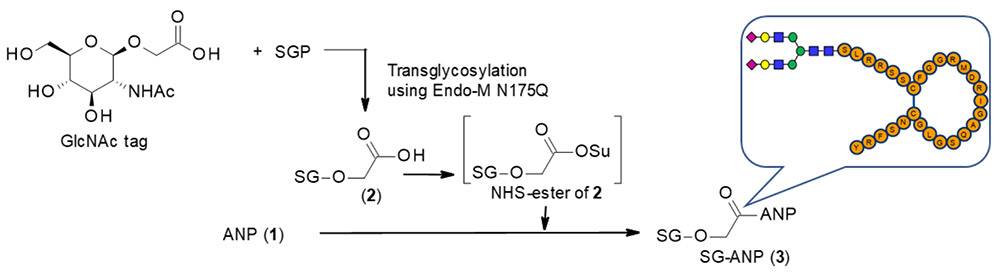
This synthetic approach is useful for selectively introducing SG glycan structures at the N-terminus or on lysine side chains of peptides, as SG glycan attachment can be achieved in a single step for oligopeptides produced in E. coli. In contrast, when introducing glycans into oligopeptides synthesized by Solid-Phase Peptide Synthesis (SPPS), excellent approaches have also been reported11.
Additionally, we conjugated glyco-modified ANP to a monoclonal antibody (mAb) or an Fc fragment via chemo-enzymatic glyco-engineering using Endo-S D233Q/Q303L as shown in Fig. 2. The most potent derivative, the SG-ANP-Fc conjugate, extended the half-life to 14.9 days and prolonged the blood pressure-lowering effect to over 28 days8. This approach is unique in that ANP was conjugated to a neonatal Fc receptor (FcRn) binder and further glyco-modified to address its vulnerability to NEP in plasma. The SG-ANP-Fc conjugate represents the longest-acting ANP among chemically modified ANP derivatives reported to date, exhibiting a pharmacokinetic profile that could enable outpatient therapy via weekly or monthly administration.
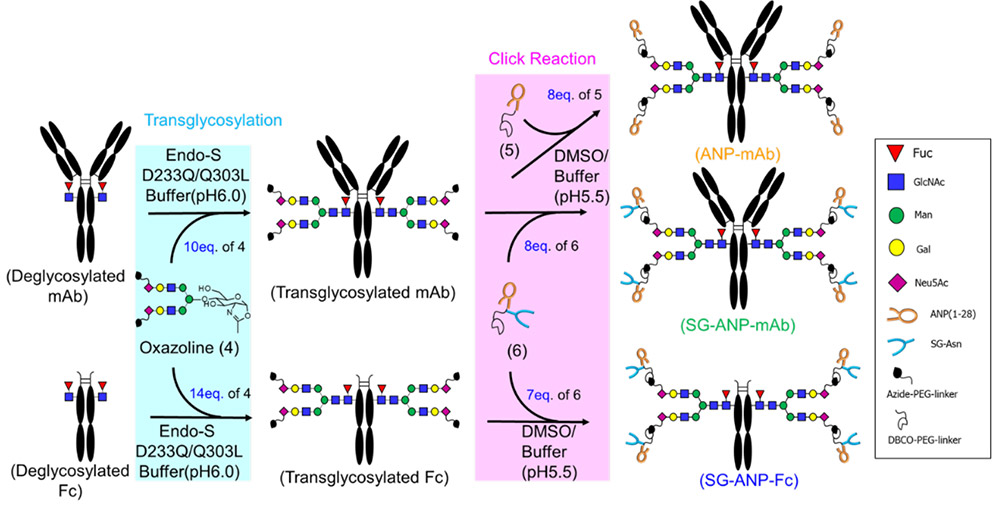
Since the report on the production of glyco-modified mAbs using the endoglycosidase Endo-S and its mutants Endo-S D233A and Endo-S D233Q12, various efforts have been made to identify potent endoglycosidase and their mutants. To date, efforts to expand substrate specificity and improve reaction efficiency have led to the identification of enzymes such as Endo-S13, Endo-S214,15, Endo-Sd, and Endo-Sz16, as well as their variants. In this chapter, we present our research in which we identified novel Endo-S variants with the aim of improving reaction efficiency.
Chemically synthesized glycan oxazoline, which works as a transition state analogue substrate for ENGase, is considered to be essential for chemoenzymatic glycoengineering. Although this method is highly effective, achieving glycan transfer rates of over 90% under optimized conditions, the re-hydrolysis of antibody glycans by ENGase presents a significant challenge. While excessive amounts of glycan oxazoline are added to the system to suppress this re-hydrolysis, as demonstrated by Parsons et al., high concentrations of glycan oxazoline cause non-enzymatic glycation of lysine residues, compromising site-specific glycan modification17. Consequently, efforts have been made to suppress glycation by optimizing reaction pH and glycan addition methods17,18 Since a large excess of glycan oxazoline was still required even after condition optimization, we decided to identify new Endo-S variants that suppress hydrolysis activity while enhancing glycosyl transfer activity, with the aim of reducing the amount of glycan oxazoline.
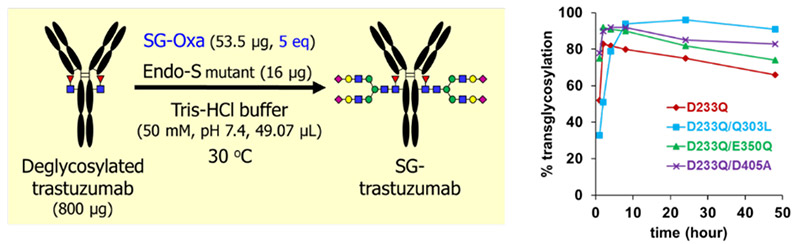
In our efforts, over 120 Endo-S mutants were screened with the aim of obtaining an efficient enzyme with improved trans-glycosylation activity and reduced hydrolysis activity13. While none of the single mutants outperformed the D233Q mutant, several multiple mutants exhibited reduced hydrolysis efficiency while maintaining comparable or improved trans-glycosylation efficiency. Among these, by introducing additional mutations into the D233Q mutant, we obtained significantly improved Endo-S mutants (D233Q/Q303L, D233Q/E350Q, and D233Q/D405A) with trans-glycosylation efficiencies exceeding 90% at a donor-to-acceptor ratio of five (Fig. 3). As part of the endoglycosidase profile, the Q303L, E350Q, or D405A mutation combined with D233Q resulted in a slight reduction in hydrolysis efficiency and improved maximum trans-glycosylation efficiency.
Despite promising recent research results in the field of drug discovery applications, there are still challenges for the industrial use of glycan engineering technology via chemoenzymatic approaches, including the complexity of manufacturing processes and production costs19.
The process of modifying antibody glycans using a chemoenzymatic approach involves two stages. First, wild-type ENGase cleaves the host cell-derived glycans on antibodies. Then, the desired glycans are transferred with ENGase mutant to deglycosylated antibodies from the donor glycan moieties. In general, ENGase is added to the antibody in a batch process and a highly specific purification step, such as the Protein A chromatography step, is required in the downstream steps following enzyme reaction steps to prevent the deglycosylation of the glycoengineered product. Since enzymes used for both the deglycosylation step and the transglycosylation step must be removed from antibodies after enzyme reaction steps, these additional multi-step purification processes contribute to the increased production cost of glycan-modified antibodies. Furthermore, the cost to obtain the highly purified enzyme is also a major bottleneck in manufacturing glycoengineered antibodies via the chemoenzymatic approach. Therefore, recent research aimed at industrial application has explored methods to simplify the scheme for producing glycoengineered antibodies with less effort. Several reports, in particular, have shown that the immobilization of enzymes enables the streamlining of the antibody glycoengineering process20-22. In these attractive schemes, the enzyme immobilized on the solid phase, such as a magnetic bead and chromatography resins, can be easily separated from antibodies after reaction via centrifugation or filtration or both.
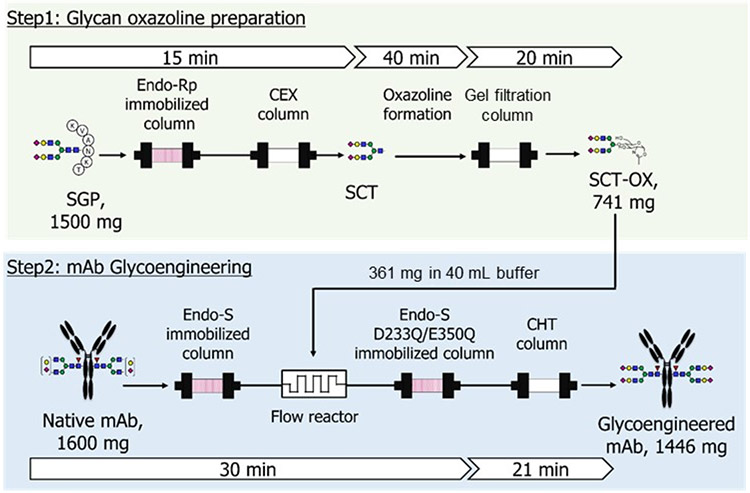
Recently, we developed an advanced scheme to produce glycoengineered antibodies by applying flow chemistry technology in addition to enzyme immobilization techniques23. In our system, multiple monolithic columns which immobilized wild-type Endo-S and Endo-S D233Q/E350Q respectively via histidine tags are connected with the flow reactor (Fig. 4, Step 2). After deglycosylation of the antibody glycan derived from CHO cells is achieved on the wild-type Endo-S immobilized column, the transglycosylation reaction proceeds effectively on the Endo-S D233Q/E350Q immobilized column since the deglycosylated antibody and the glycan oxazoline are mixed in the flow reactor connected between both columns. The established scheme enables the automation for the production of the glycoengineered antibody from the native antibody, as it performs two enzymatic reactions in a flow system without intermediate purification steps. Furthermore, the same approach was also applied to the preparation of the glycan oxazoline (Fig. 4, Step 1). The hydrolyzed product of SGP was rapidly obtained in the flow system with the wild-type Endo-Rp immobilized column. The developed combination scheme showed that glycoengineered antibody could be obtained on a gram scale from the starting materials (SGP and the native antibody) within 2.5 hours.
From the perspective of streamlining the manufacturing process, the one-step synthesis method using wild-type ENGase is a noteworthy approach. Shi and Zhang and their co-authors reported that the glycoengineered antibodies could be synthesized in a single step using optimized oxazoline disaccharide derivatives and wild-type Endo-S2, respectively24,25. This promising method enables both the deglycosylation of native antibodies and the transglycosylation in a single step since the glycosylated product resists the deglycosylation activity of wild-type Endo-S2.
Chemically synthesized glycan oxazoline is essential for the glycoengineering of antibodies in the typical chemoenzymatic approach26. However, the undesirable glycation of lysine residues and the degradation of glycan oxazoline are challenges for the industrial use of this approach19. It has been well known that oxazoline is labile to hydrolysis in an aqueous solution. Particularly in the acidic to neutral pH range selected to avoid glycation, glycan oxazoline is rapidly hydrolyzed27. Therefore, manufacturers should make a considerable effort to maintain consistency in the quality of glycan oxazoline across the entire supply chain, from the production and storage of glycan oxazoline to the enzyme reaction step of antibody manufacture.
Against this background, the development of alternative methods that do not require chemically synthesized glycan oxazoline is highly valuable. In our efforts, we have developed a novel one-pot trans-glycosylation reaction to circumvent the use of glycan oxazoline13. We tested combinations of endoglycosidase mutants with varying target specificities, i.e., an Endo-S mutant that preferentially targets Fc N-glycan and an Endo-M mutant that targets SGP but not core-fucosylated Fc N-glycan. Figure 5 shows the efficiency of glycan transfer to antibodies using SGP as a glycan donor, with each enzyme used alone or in combination. Transglycosylation efficiency remained as low as 13% when Endo-S D233Q was used alone or in combination with wild-type Endo-M, and similarly low efficiency was observed with the combination of wild-type Endo-S and Endo-M N175Q (Fig. 5A). In contrast, combining Endo-S D233Q with Endo-M N175Q resulted in high transfer rates; in particular, a maximum transfer rate of 97% was achieved when Endo-S D233Q/E350Q was used (Fig. 5B). However, the reaction rate tended to decrease slightly when Endo-S D233Q/Q303L was used as catalyst or SG-Asn was used as the substrate glycan.
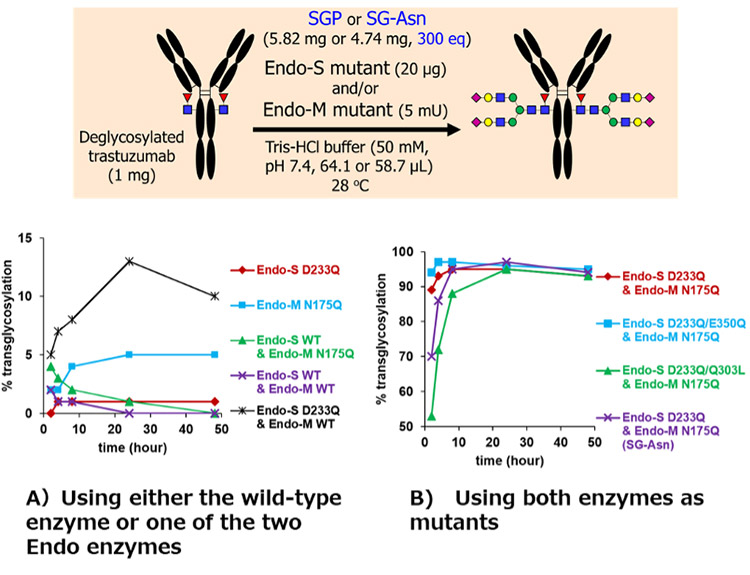
Figure 6 shows the proposed scheme of the reaction. In this one-pot reaction, SGP is primarily and reversibly converted into GlcNAc-peptide and an active intermediate on enzyme by Endo-M (1 in Fig. 6). Depending on the hydrolytic activity of Endo-M, this intermediate is irreversibly hydrolyzed either rapidly or slowly (2 in Fig. 6). If this hydrolysis is sufficiently slow to be negligible, the intermediate produced by Endo-M can be utilized by another endoglycosidase, Endo-S, for conjugation to the antibody (3 in Fig. 6). Similarly, SG-mAb is reversibly converted into GlcNAc-mAb and an active intermediate on enzyme by Endo-S (3 in Fig. 6), followed by irreversible hydrolysis, either rapid or slow (2 in Fig. 6) depending on the hydrolytic activity of Endo-S. This reaction is distinctive in that the active intermediate generated by Endo-M is available for utilization by another endoglycosidase, Endo-S.
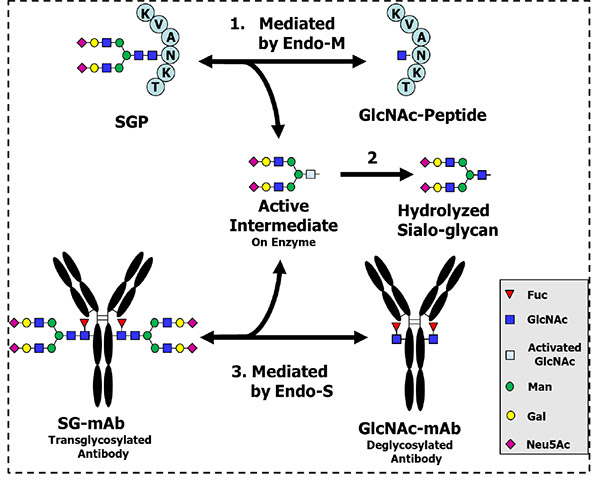
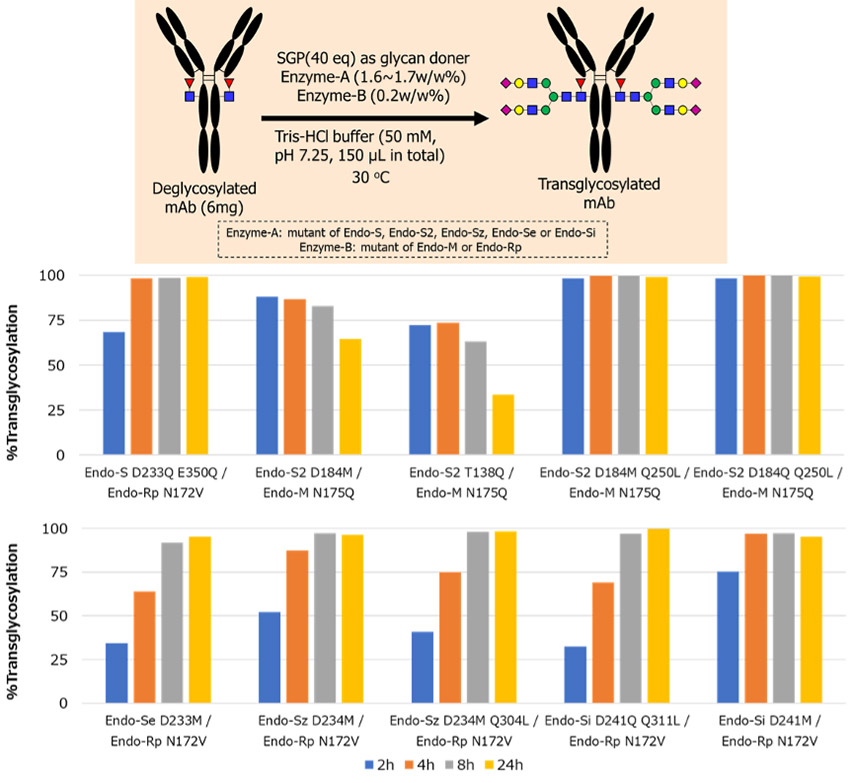
Considering that SGP and SG-mAb act as glycan donors while GlcNAc-peptide and GlcNAc-mAb serve as glycan acceptors until the reaction stops, it is important to minimize the impact of irreversible hydrolysis (2 in Fig. 6) occurring from the active intermediate on the enzyme Endo-M / Endo-S. In this context, transglycosylation using two mutant endoglycosidases would be a promising approach, combining enzymes such as Endo-M, Endo-CC28, Endo-Om29, or Endo-Rp30 from glycoside hydrolase family 85, with Endo-S, Endo-S231, Endo-Sd32, Endo-Sz16, Endo-Se32, and Endo-Si, an endoglycosidase derived from Streptococcus iniae33, from glycoside hydrolase family 18. In our efforts to develop more efficient conditions using two endoglycosidases, some related investigations have been disclosed. Although not described in detail here, by combining appropriate reaction conditions and enzymes with suitable reactivity, it was possible to reduce the amount of SGP, the glycan donor, used in the reaction. Figure 7 shows an example comparing the percentage of transglycosylation at 2, 4, 8, and 24 hours using 40 equivalents of SGP with different combinations of enzymes.
Here, we focused on ENGase-catalyzed synthesis of glycosylated ANP derivatives, the generation of efficient endoglycosidase mutants, and research aimed at the production of glycoengineered antibodies at industrial scale. While the production of glycan raw materials and activated forms was not included in this review, numerous research groups continue to file various patents in the field of glycan production. As these trends indicate, the stable and cost-effective supply of glycans that serve as substrates for ENGase represents a critical challenge for the industrial application of chemoenzymatic glycoengineering technologies.