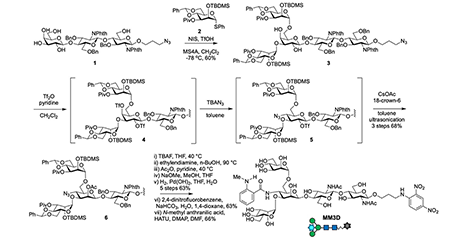
Endo-β-N-acetylglucosaminidase (ENGase) is an endoglycosidase that acts on the N,N’-diacetylchitobiose core of asparagine-linked glycans (N-glycans), cleaving the β-glycosidic linkage. ENGase is widely utilized as a research tool for glycan structural analysis because it releases N-linked glycans from glycoproteins. Additionally, ENGase is employed for glycoprotein glycan remodeling, with expanding applications in drug discovery research, making it an industrially valuable enzyme. To facilitate further ENGase studies, simple methods for detecting the glycoside hydrolase activity of ENGase are required. However, most existing activity assays require tedious manipulations. In this article, we introduce FRET (Förster resonance energy transfer)-quenching-based glycan molecular probes, developed through chemical glycan synthesis, that enable simple, highly sensitive, high-throughput, and real-time detection of ENGase activity and are suitable for inhibitor screening. ...and more
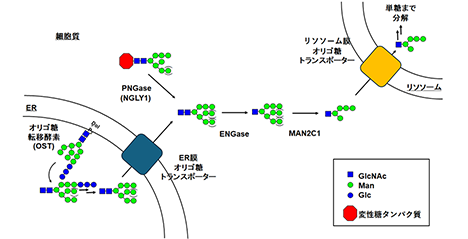
Endo-β-N-acetylglucosaminidase (ENGase) hydrolytically cleaves the glycosidic linkage in the N,N’-diacetylchitobiose moiety of the core region of N-linked glycans (N-glycans), and it has long been widely used as a tool for structural analysis of N-glycans. It has been suggested that cytosolic ENGases, which are widely distributed in animal cells including human cells, are involved in the degradation of free N-linked glycans (FNGs), but recently the ability of cytosolic ENGases to act directly on proteins has also been shown. While Engase-knockout (KO) mice show no particular phenotypes, deletion of the Engase gene can partially suppress embryonic lethality caused by gene knock-out of the Ngly1 gene, which encodes peptide:N-glycanase (PNGase), i.e., another cytosolic deglycosylating enzyme acting on N-glycans. ENGase is thus attracting attention as a potential drug target for NGLY1 deficiency, a rare human genetic disorder. Recently, part of the molecular mechanism by which ENGase suppresses the phenotype in Ngly1-KO mice has been clarified, revealing that it is quite complex, involving the E3 ubiquitin ligase complex SCFFBS2- ARIH1. ...and more
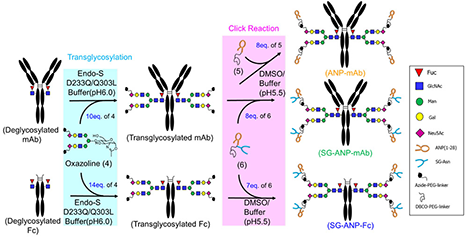
Glyco-engineering is an advanced technology that artificially designs and modifies the composition and structure of glycans bound to biomolecules such as peptides and proteins. In the biopharmaceutical field, a wide range of approaches have been investigated that aim to enhance functionality, enhance target specificity, and reduce side effects by modulating drug properties such as stability, efficacy, safety, and pharmacokinetics. Particularly, chemoenzymatic glycoengineering of monoclonal antibodies using endo-beta-N-acetylglycosaminidase (ENGase) is known to provide useful tools such as linkers for site-specific conjugation of drugs to antibodies. This review provides recent updates of drug discovery research using chemoenzymatic approaches and developments to overcome challenges in large-scale production....and more
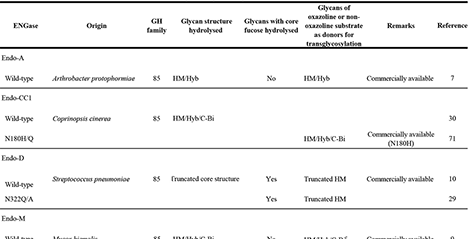
Glycans play important roles in protein function, stability, intermolecular interaction, and so on. These are highly related to glycan structures in many cases. However, the structure of the glycan attached to the specific glycosylation site usually varies in each molecule of glycoprotein, and this variation gives rise to the heterogeneity and functional differences between glycoproteins. Therefore, glycan remodeling aims to increase the homogeneity and strengthen the function and stability of the glycoprotein by attaching glycans of specific structure to the glycosylation sites of the glycoprotein. The glycan remodeling techniques have been widely developed, and one of them is the endo-β-N-acetylglucosaminidase (ENGase, EC 3.2.1.96)-based method. In connection with this, this review outlines the basic knowledge of glycan remodeling and the recently identified novel ENGases that recognize the non-reducing end of N-glycans and can hydrolyze multibranched complex type N-glycans....and more
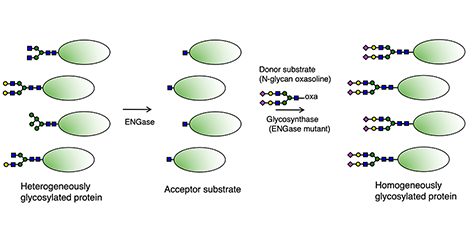
Endo-β-N-acetylglucosaminidase (ENGase) is an enzyme widely distributed among various organisms and known to hydrolyze N-glycans. Recent studies have demonstrated that strategic modification of its catalytic residues enables its conversion into a glycosynthase, thereby facilitating the chemoenzymatic remodeling of N-glycan structures.
In this series, we will discuss recent progress in glycoengineering-related ENGase research by leading experts in each field....and more