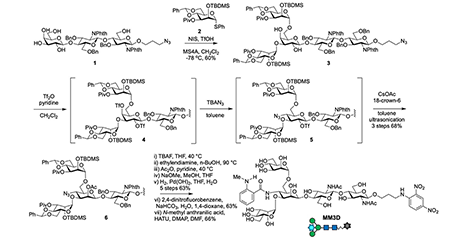
Endo-β-N-acetylglucosaminidase (ENGase) is an endoglycosidase that acts on the N,N’-diacetylchitobiose core of asparagine-linked glycans (N-glycans), cleaving the β-glycosidic linkage. ENGase is widely utilized as a research tool for glycan structural analysis because it releases N-linked glycans from glycoproteins. Additionally, ENGase is employed for glycoprotein glycan remodeling, with expanding applications in drug discovery research, making it an industrially valuable enzyme. To facilitate further ENGase studies, simple methods for detecting the glycoside hydrolase activity of ENGase are required. However, most existing activity assays require tedious manipulations. In this article, we introduce FRET (Förster resonance energy transfer)-quenching-based glycan molecular probes, developed through chemical glycan synthesis, that enable simple, highly sensitive, high-throughput, and real-time detection of ENGase activity and are suitable for inhibitor screening. ...and more
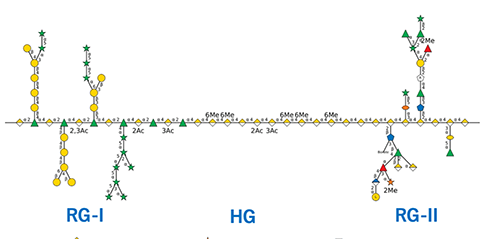
Dietary fiber is known to exert a variety of physiological functions, including promoting bowel regularity and suppressing postprandial rises in blood glucose and serum cholesterol; many of these functions have been attributed to short-chain fatty acids produced by gut microbiota fermentation or to the physicochemical effects of indigestibility. Pectin, a water-soluble dietary fiber, is not degraded by human digestive enzymes and can therefore come into direct contact with the small-intestinal epithelium before it is fermented in the large intestine. In recent years, pectin has been found to alter the morphology of small-intestinal villi and to interact in a structure-specific manner with the extracellular matrix and cell-surface molecules of epithelial cells. In this review, from the viewpoint of the homogalacturonan backbone and the rhamnogalacturonan-I side chains—two distinct structural domains that act on distinct target molecules, I summarize the current knowledge about interactions between pectin and intestinal epithelial cells, and propose a working hypothesis that pectin acts as a form of “chemical information” recognized by epithelial cells. ...and more